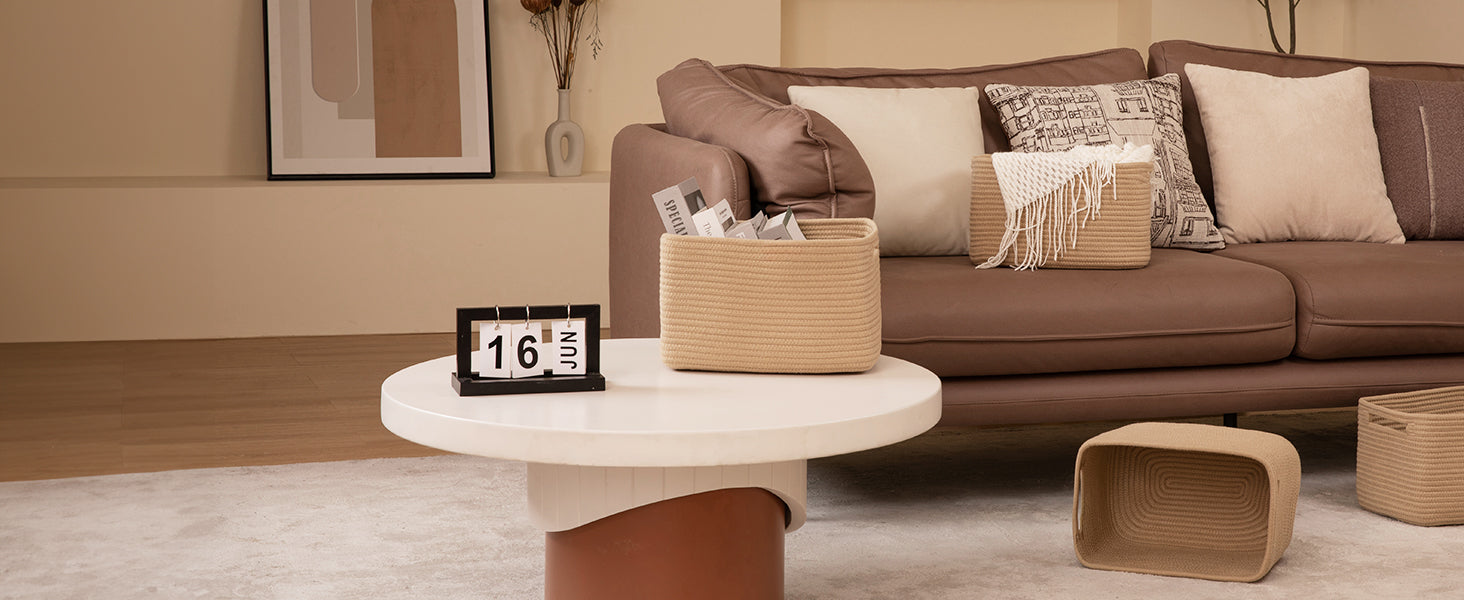


Let’s be honest: nobody fantasizes about laundry day. But if you’ve spent any time scrolling through the pristine, organized chaos of Pinterest or Instagram interiors, you’ve noticed a shift. The cracked, fluorescent blue plastic hamper is dead. In its place sits the rope basket—slouchy yet structured, neutral, and undeniably chic.
I’ve spent the last eight years investigating home organization products, testing everything from industrial wire bins to vacuum-seal bags. Here is what I know for a fact: The vessel you choose defines the chore.
Before we dive into the dirty laundry, let's address the living room. You aren't just buying a basket; you are buying a solution for "blanket creep." A jumbo rope basket is the only storage vessel capable of swallowing three bulky throw blankets while still looking intentional in a corner. Unlike rigid boxes, the rope flexes. It accommodates the overflow. It breathes. It turns a pile of mess into a deliberate design choice.

The Unvarnished Truth About the Woven Laundry Basket and Rope Basket Craze
Why the Rope Basket Conquered Your Feed
We need to talk about "visual noise."
In a small apartment or a meticulously curated bedroom, a plastic hamper screams. It reflects light; it looks cheap; it reminds you of chores. A rope basket, conversely, absorbs light. The matte texture of coiled cotton or woven seagrass adds warmth. It is camouflage for your mess. Imagine a sunny afternoon, with sunlight streaming into your living room. Would you prefer to see a cotton rope basket or a plastic basket in front of you?
But aesthetics aside, the real reason I advocate for these baskets is the "collision factor."
I have kicked plastic laundry baskets in the middle of the night. It hurts. I have dragged wicker baskets across hardwood floors, leaving scratches that required refinishing. A high-quality cotton rope basket does neither. It is silent. It is soft. If you have toddlers learning to walk or a golden retriever who plays rough, the rope basket is the only safe option. It collapses under weight rather than shattering.
The Durability Test: Stitching vs. Glue
Not all baskets are created equal. In my tear-down tests, I’ve found that cheap knock-offs often use hot glue to secure the rope ends. Avoid these. They will unravel after three months of hauling heavy denim.
You want a basket where the structural integrity comes from zigzag stitching (often polyester thread for strength) binding the cotton coils. When I inspect a woven laundry basket, I look for a high stitch density. I pull at the handles. If the handle is just a separate piece of rope sewn on top of the rim, put it back. You want handles that are integrated into the body of the basket or reinforced with rivets. A fully loaded basket of towels weighs about 15 to 20 pounds; a glued handle will snap before you make it to the washing machine. This is so frustrating!

Decoding Materials: Cotton, Jute, and Seagrass
The term "woven" is thrown around loosely in marketing. Understanding the fiber is the difference between a basket that lasts a decade and one that shreds your favorite sweater.
The Cotton Rope Basket: The Soft Giant
This is the gold standard for versatility. Made from coiled cotton ropes stitched together, these are heavy, pliable, and washable. Yes, washable. I have thrown entire rope baskets into the washing machine on a gentle cycle (air dry only, please) to remove dust and pet hair. You cannot do that with wicker.
Because cotton is smooth, it is the only responsible choice for delicate fabrics. Silk blouses and fine knits can snag on the rough reed of a traditional wicker basket. In a rope basket, your cashmere is safe.
The Natural Fiber Woven Laundry Basket (Seagrass/Hyacinth)
These offer that structured, organic farmhouse look. They are stiffer than rope. They stand up straighter and don't "slouch." However, they are brittle. Over time, dry seagrass sheds.
If you choose this route, you must ensure the basket has a canvas or linen liner. Without a liner, the raw woven material will snag your leggings. I strictly recommend lined seagrass baskets for laundry; unlined ones are better suited for firewood or shoes.

The Breathability Factor: Why Your Clothes Smell
Let’s get technical about mildew.
Plastic hampers are moisture traps. If you throw a damp gym towel into a solid plastic bin and leave it for three days, anaerobic bacteria thrive. That distinct "sour" smell is hard to wash out.
A woven laundry basket is inherently breathable. The gaps between the coils or weaves allow air to circulate through the dirty pile. Even if the clothes are tightly packed, the material itself (especially natural cotton or jute) absorbs and wicks away ambient moisture.
Previously, I didn't realize the difference in materials for storage baskets, and I just bought a cheap plastic one. It was very inexpensive, but after using it for a while, I discovered my sportswear was getting moldy, which was terrible. Only after buying a new cotton rope basket did the situation improve. this isn't just a style choice—it's a hygiene requirement.
The Case for the Woven Laundry Basket with Lid

Open baskets are great for throwing things in from across the room (we all do it). But for a master bedroom or a bathroom shared with guests, you need concealment.
The woven laundry basket with lid is a sub-category that deserves more attention. The engineering here matters. I despise lids that are completely detached—you will lose them, or they will end up on the floor.
Look for a "hinged" effect, often created by leather straps or flexible weaving. A lid transforms the basket from a receptacle into a piece of furniture. I’ve seen clients use a sturdy, lidded woven basket as a makeshift side table in a pinch. It keeps the visual line of the room uninterrupted. If your laundry basket is visible from the hallway, a lid is non-negotiable.
The "Squashed" Arrival: A User’s Guide to Reshaping
Here is the one complaint I see in 1-star reviews that drives me crazy: "It arrived folded and looks like a flat tire."
Listen to me: This is a feature, not a bug. To make these affordable and eco-friendly to ship, rope baskets are folded. They will not look perfect out of the box.
Do not panic. You have two options to fix this, and both work beautifully:
-
The Patience Method: Stuff the basket to the brim with pillows, comforters, and towels. Really pack it tight. Leave it for 48 hours. The cotton fibers have "memory"—they will relearn the round shape.
-
The Iron Method (My Preference): If you own a steamer, blast the creases. If not, use a steam iron with a wet towel between the iron and the basket. The heat relaxes the cotton fibers instantly. It takes five minutes, and the basket will look like it cost $100 at a boutique.
Sustainability: A Handcrafted Narrative
We are moving away from the disposable economy. A plastic laundry basket eventually cracks. When it does, it becomes jagged trash that sits in a landfill for 500 years.
A woven laundry basket—particularly those made from unbleached cotton or renewable seagrass—has a different lifecycle. Cotton is biodegradable. Even the synthetic stitching used in rope baskets is a fraction of the waste produced by a solid PVC bin.
Furthermore, many of these baskets are handcrafted. While mass-manufactured versions exist, the nature of coiling rope or weaving seagrass requires human hands. There is a slight variation in every piece—a stitch that’s a millimeter off, a slight undulation in the rim. This isn't a defect; it's character. In a world of perfect, sterile machine-made goods, having something with a bit of "hand" feels grounding.
Final Verdict
If you are looking to upgrade your home organization, the rope basket is the entry point. It is versatile enough for blankets, toys, and laundry. It is safe for kids and forgiving on floors.
However, if you are strictly looking for a heavy-duty hamper for a family of four, invest in a large, structured woven laundry basket with lid. Ensure it has a liner if it's made of rougher natural fibers, and check the stitch quality on the handles.
Your laundry will still be a chore. But with the right basket, at least it won't be an eyesore.