

There is a specific kind of anxiety that comes from staring at a pile of unspun merino wool or a mountain of fat quarters that has slowly migrated from the desk to the floor. It is the anxiety of potential. Every scrap represents a project, a dream, a moment of future creativity. But when those dreams are piled in a chaotic heap, they feel less like inspiration and more like a burden.
Most craft storage ideas found online suggest rigid solutions: wall-to-wall pegboards that collect dust, or brittle plastic drawer units that yellow over time and crack under pressure. While these have their place, they often ignore the tactile nature of the materials being stored.
The Psychology of the "Stash": Why We Need Better Systems

To understand storage, one must first understand the stasher. The fabric collector does not hoard out of malice; they collect because they see possibility. The knitter buys yarn not for the sweater they will make today, but for the person they hope to be next winter.
However, traditional organization methods often punish this abundance. Transparent bins create visual chaos—a riot of conflicting colors that can overwhelm the eye. Open shelving demands perfection in folding that few have time to maintain.
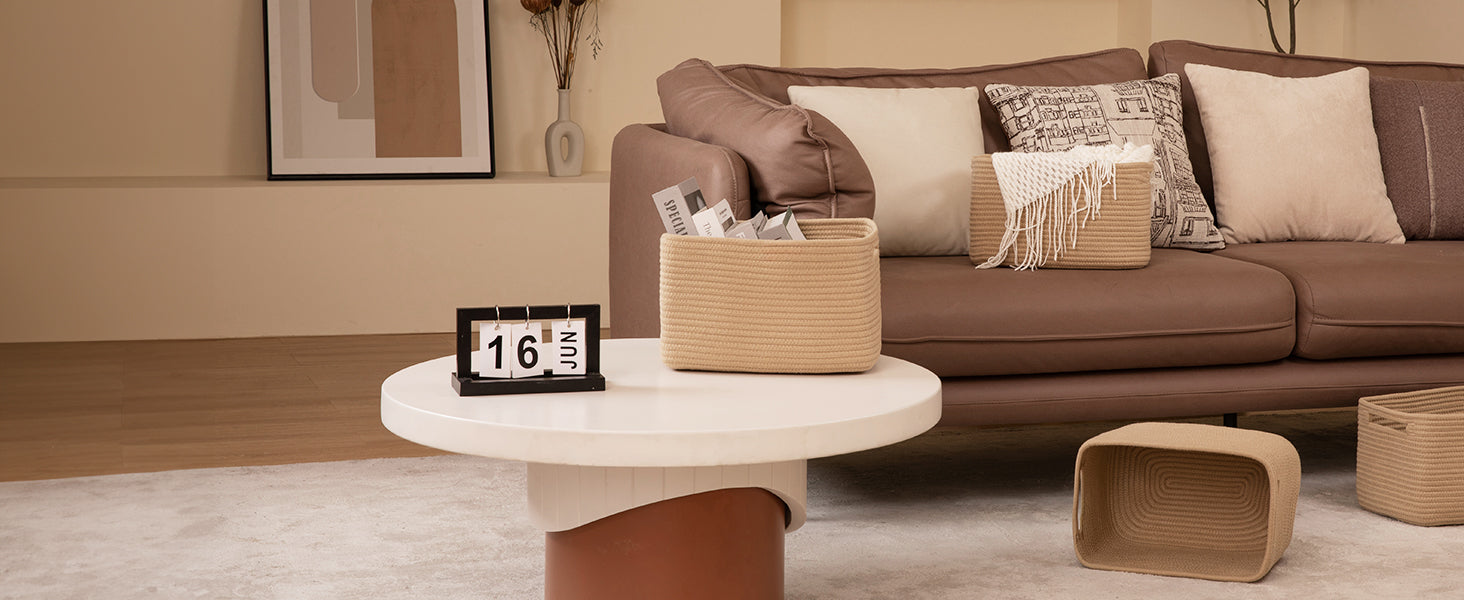
This is where the concept of "Visual Quieting" comes into play. By utilizing opaque, textured storage solutions like coiled rope baskets, the visual clutter is contained. The room feels softer. The acoustics dampen. The environment shifts from a warehouse of parts to a sanctuary of creation.
For the Fiber Artist: Why Wicker is the Enemy
If you knit, crochet, or weave, you know the heartbreak of a snag. You reach for a skein of hand-dyed alpaca blend, only to find it caught on the rough edge of a wicker basket or the sharp burr of a plastic injection mold. The fiber frays. The integrity of the twist is ruined.
The Snag-Free Sanctuary
For the fiber artist, the primary requirement of any storage vessel is a smooth interior. This is where the cotton rope basket outperforms almost every other option.
-
The Smooth Coil: Unlike rattan or wire, cotton rope is continuous and soft. There are no sharp ends to catch on delicate mohair or silk blends. The yarn glides against the cotton rather than fighting it

-
Breathability: Wool needs to breathe. Sealing natural fibers in airtight plastic bins can trap residual moisture, leading to mildew or that distinct "stale attic" smell. Cotton allows for air circulation while still protecting the fiber from dust and direct sunlight, which can fade dyes.
Organizing by Weight and Blend
Instead of throwing all yarn into one giant bin, consider a modular approach using medium-sized baskets:
-
The WIP (Work in Progress) Vessel: A dedicated basket that sits by the armchair. It holds the current sweater, the needles, and the pattern. Because the basket is soft, it can be squeezed between the sofa and the end table without breaking.
-
The Weight Separation: Use separate baskets for lace weight, DK, and worsted. This makes "shopping your stash" easier. When inspiration strikes for a chunky scarf, one simply grabs the "Bulky" basket.
Taming the Fabric Mountain: A Solution for Sewists
Fabric is heavy. A stack of denim or canvas can weigh twenty pounds easily. When stacked on open shelves, these piles have a tendency to slump, slide, and eventually topple, creating an avalanche of textiles.
The "File Fold" Technique
The most efficient way to store fabric is not in a horizontal stack, but vertically, like files in a cabinet. This method, popularized by organizers like Marie Kondo, allows you to see every pattern at a glance without disrupting the pile to get to the bottom piece.
However, file folding requires a container with structural integrity that is also forgiving. Rigid boxes often don't fit the width of a standard fat quarter perfectly, leaving dead space.

Why flexible baskets work here:
-
Adaptive tension: A rope basket has a slight "give." If the fabric row is an inch too wide, the basket flexes to accommodate it. It holds the fabric upright through tension, keeping the folds crisp.
-
The Heavy lifter: Cotton rope is surprisingly strong. A well-constructed basket with reinforced stitching can hold a significant weight of fabric without the bottom bowing out, a common failure point in cardboard-reinforced fabric bins.
Managing Scraps
Every sewist has "The bag." The plastic grocery bag filled with weirdly shaped off-cuts that are too small for a garment but too big to throw away.
Replace the plastic bag with a small, shallow rope bowl on the cutting table. It turns the "trash" into a textural display. When the bowl is full, it signals that it is time to do a scrap-busting project or stuff a pouf. It turns waste management into a mindful ritual.
The "Momager" Strategy: Kid-Safe Art Supplies
For the parent managing a household of budding artists, craft storage ideas must prioritize two things: safety and speed.
Acrylic organizers crack when dropped. Metal tins have sharp edges. Wooden crates are heavy and can crush little fingers. When a three-year-old decides to dump out the crayon bin, the container itself shouldn't be a hazard.
The One-Minute Cleanup
The reality of crafting with children is that the cleanup needs to happen now, usually right before dinner or bed. Precision organizing (lining up markers by color cap) is a fantasy.
-
The Dump Bin: Large, open-top rope baskets are ideal for "dump storage." Markers, glue sticks, pipe cleaners, and pompoms can be swept off the table and into the basket in seconds.
-
Safety First: If a toddler trips and falls onto a cotton basket, they bounce off. If they pull it down from a shelf, it won't cause a concussion. This peace of mind allows parents to place storage at child-height, fostering independence. "Get the art basket" becomes a safe command, rather than a hovering supervision task.
Categorizing the Chaos
Assign colors or sizes to categories.
-
Tall Baskets: For long items like rolls of paper, rulers, and oversized coloring books.
-
Wide, Low Baskets: For the "digging" items—LEGOs, beads (in sealed bags), or clay tools. The wide mouth allows children to see what is inside without dumping the contents—though let's be honest, they will dump it anyway. But at least the basket won't break.
Small Space Solutions: The Portable Studio
Not everyone is blessed with a dedicated "cloffice" (closet-office) or a spare room. For the apartment dweller or the dorm student, the craft room is often the coffee table.
In small spaces, storage cannot be hidden; it is part of the furniture. A plastic Sterilite tower in the corner of a living room is an eyesore. A set of woven rope baskets, however, contributes to the decor. It bridges the gap between functionality and interior design.
The Mobile Module
The modern crafter is nomadic. You might cut fabric on the kitchen island, sew at the dining table, and do hand-finishing on the sofa.
-
Handle Strength: This is where the construction of the basket becomes vital. Look for baskets with integrated, reinforced handles. You want to be able to lift a basket full of hardcover sketchbooks or heavy clay blocks with one hand and transport your "studio" to the next location.
-
Under-Table Efficiency: Round baskets are particularly good at utilizing the dead space under side tables or console tables. They slide in and out easily, turning wasted floor space into a yarn vault or a sketchbook archive.
The Aesthetic Desk: Hiding the Ugly

We live in the age of the "Desk Setup." We want our spaces to look like the Pinterest boards that inspire us. But the reality of crafting is that some tools are just ugly. Glue guns, heat tools, blister packs of batteries, and tangled charging cables are necessary but unsightly.
Reducing Visual Noise
There is a concept in design called "visual noise"—the clutter of text, logos, and contrasting colors that tires the brain. Craft supplies are notoriously noisy. Every tube of paint has a logo; every spool of thread has a barcode.
Using open shelving to display these items can make a room feel chaotic, even if it is technically organized.
The Hidden Layer:
-
Uniformity: Using a set of matching cotton baskets on a shelf creates a calm, uniform façade. The eye glides over the cream or grey texture of the rope, ignoring the chaos of cables and glue sticks hiding inside.
-
Texture as Decor: The texture of coiled rope adds warmth to a room that might otherwise be filled with cold, hard surfaces like cutting mats and metal scissors. It brings a "Boho" or "Scandi" element that softens the industrial nature of craft tools.
The Journaling Station
For the paper planner and journaler, small baskets are perfect for corralling washi tape. Unlike a drawer where tapes roll to the back, a shallow basket keeps them contained but accessible. It allows you to sift through them, enjoying the tactile experience of choosing a tape, rather than scanning a rigid plastic dispenser.
Selecting the Right Basket: A Brief Buyer’s Note
Not all rope baskets are created equal. When selecting a vessel for craft storage ideas, one must look for density and stitching quality. A basket that is too floppy will frustrate the fabric stasher; it needs to stand up on its own even when empty.
Look for:
-
Tight Coiling: The rope should be sewn tightly to prevent gaps.
-
Reinforced Stitching: Especially at the handle points.
-
Natural Materials: 100% cotton is preferred over synthetic blends, as it breathes better and doesn't off-gas plastic smells onto your materials.
Conclusion: Reclaiming the Joy of Making
The goal of organizing a craft space is not to achieve a sterile, magazine-ready look that is too precious to touch. The goal is to lower the barrier to entry. When you want to create, you shouldn't have to fight your supplies.
By choosing storage that is kind to your materials—soft, breathable, and snag-free—you are showing respect for your craft. You are acknowledging that the wool, the silk, and the linen are valuable. And by choosing storage that is kind to your eyes—hiding the clutter in beautiful, textural vessels—you are being kind to yourself.
Whether you are a master quilter or a toddler with a glue stick, the right storage doesn't just hold your things. It holds the potential for your next masterpiece.