

Making Peace with the Triangle
There is a particular kind of loneliness that lives under the stairs.

In most rental apartments, this space is an architectural afterthought—a triangular void that feels too awkward to be useful, yet too large to ignore. So, it becomes a graveyard. It holds the vacuum cleaner you resent using, the winter coats that smell faintly of attic dust, and that box of "miscellaneous" cables you’re afraid to throw away. Every time you walk past it, that little shadow of clutter tugs at your peace of mind.
I want to offer you a different perspective.
You do not need to own the deed to your house to have a home that feels finished. You do not need to hire a carpenter to create a sense of order. In fact, some of the most beautiful and functional under stair storage ideas are entirely temporary, respecting both your lease agreement and your need for a sanctuary. Let’s look at how we can gently reclaim this space, turning a dusty corner into a pocket of calm.
The Art of the "Faux" Built-In
When you scroll through Pinterest, you see gorgeous, custom-milled cabinetry perfectly fitted under staircases. It’s lovely, and it is also entirely out of reach for us renters. But we can borrow the spirit of that design without the sawdust or the eviction notice.
The secret is modular adaptation.
Instead of trying to find one piece of furniture that fits the slope perfectly (it doesn't exist), visualize the space as a series of descending steps. You can achieve a "custom" look by using standard cube organizers—think the IKEA KALLAX or similar sturdy units—stepped down in height. A 4x4 unit, next to a 2x2 unit, effectively mimics the slope of the stairs.
But here is where the "gentle" part comes in. Open cubes are visually loud. If you fill them with naked books, papers, and toys, you haven't solved the clutter; you've just framed it.
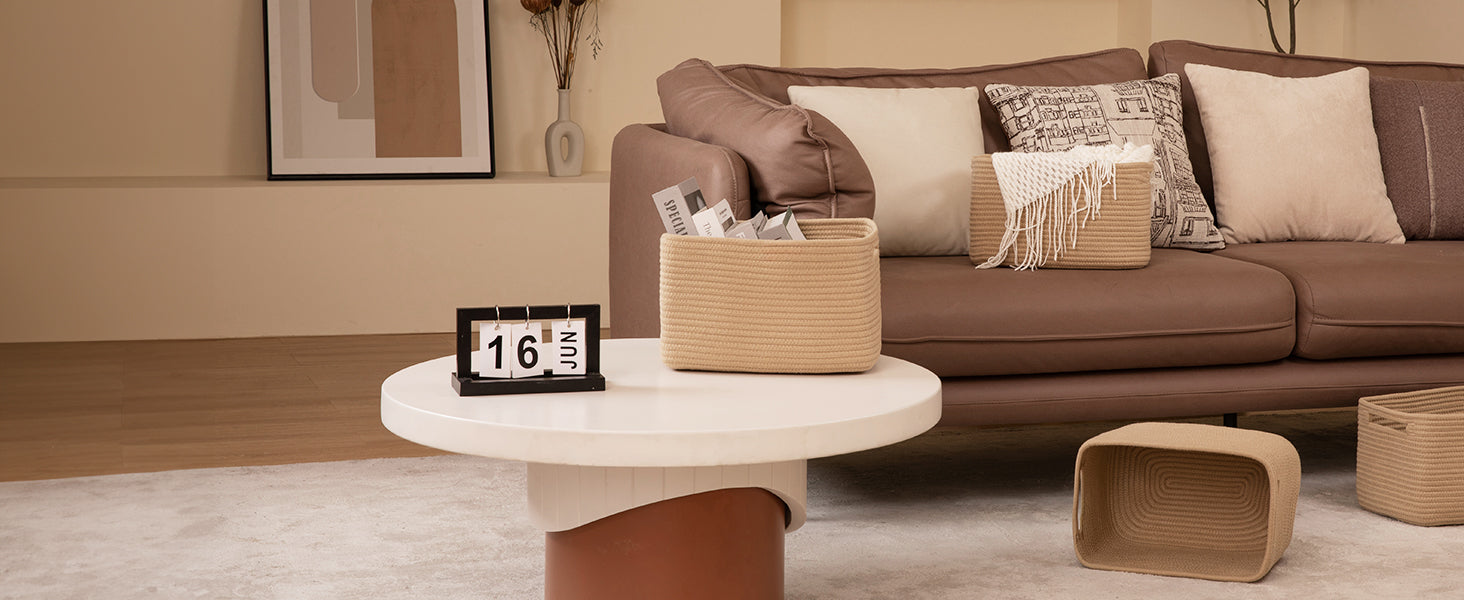
This is where the concept of the "soft drawer" becomes essential. By filling these open cubes with uniform cotton rope baskets for shelf, you create a wall of texture rather than a wall of chaos. I prefer rope baskets over wicker or plastic for rentals specifically because they are kind to the property. Wicker scratches the paint inside the cubby; plastic scrapes the laminate flooring when you pull it out. Cotton slides. It’s silent. It respects the house, ensuring you get your security deposit back while giving you the hidden storage of a dresser.

Occupying the "Awkward Triangle"
The most frustrating part of under-stair storage is the acute angle—that sharp, low point where the stairs meet the floor.
Rigid furniture fails here. A square plastic bin cannot fill a triangular space; it leaves a gap of unused air above it and behind it. A wooden chest is often too bulky to slide all the way in. This little wedge of space is usually surrendered to dust bunnies.
I have found that the best way to honor this space is to stop fighting its geometry with rigid lines. Use flexible storage.
A large, malleable storage basket is perfect here. Because a rope basket has structural "give," it can be nudged right into that low eaves space. It doesn't need to be a perfect square. It can hold the bulky, amorphous items that act like fluid—spare blankets, winter duvets, or the collection of plush toys that seem to multiply when you aren't looking.
By placing a large, soft vessel in this low spot, you turn a dead zone into a purposeful "landing pad." It looks intentional. Instead of a dark corner where dirt gathers, it becomes a textural moment—a soft curve tucked into a sharp angle. It invites you to use it, rather than scaring you away with its awkwardness.
Light, Air, and the "Stuffiness" Factor

We need to talk about the air under there.
If your under stair storage ideas involve an enclosed closet (the "Harry Potter" cupboard), you are likely dealing with stagnant air. These spaces rarely have ventilation. If you pack them tight with plastic tubs, you create a micro-climate that traps moisture. I have opened plastic bins stored under stairs after a year, only to be greeted by that distinct, stale "old house" smell.
This is another reason I gently steer renters toward breathable materials.
Natural fibers, like cotton rope or canvas, allow your belongings to breathe. They don't seal moisture in. If you are storing linens, seasonal clothing, or even shoes under the stairs, airflow is a preservation strategy.
Furthermore, these dark spaces need visual lightness. A dark cupboard filled with dark boxes feels heavy. It feels like a burden. Choosing storage vessels in light, neutral tones—creams, soft grays, oatmeal—acts as a reflector. Even a small amount of light that creeps in when you open the door will bounce off these lighter surfaces, making the space feel cleaner and more expansive than it actually is. It’s a small psychological trick, but it changes the feeling of opening that door from dread to ease.
The "Mobile Pantry" Concept for Deep Spaces

Some of you are blessed (and cursed) with deep under-stair storage. The kind where you can lose a suitcase in the back.
The instinct is to shove things in, layer by layer. But this archaeology method means you will never use the things in the back again. You will buy a new sleeping bag because you cannot face the effort of excavating the old one.
For renters, since we cannot install pull-out drawer systems on tracks, we must put the storage on wheels.
I recommend measuring the width of your doorframe and finding low-profile rolling carts or dollies. You can stack your storage baskets on these dollies. When you need the Christmas decorations stored in the very back, you simply roll out the front carts.
Treat the space like a parking garage, not a landfill.
If you don't want to buy carts, use the "slide" method. Felt furniture pads stuck to the bottom of your larger bins work wonders on hardwood or tile. But again, be mindful of the weight. Heavy boxes are hard to pull. This is why I often limit the size of the containers I use under stairs. Two medium-sized baskets are infinitely easier to manage than one giant tote that requires a deadlift to move. Be kind to your back.
Categorizing for Real Life (Not Instagram)

There is a pressure to organize by color or to have perfectly printed labels. If that brings you joy, do it. But for most of us, life is messier than that.
Under the stairs is often the "Transition Zone." It’s where things go when they are leaving the house or just coming in.
I suggest dedicating at least one easily accessible open bin as a "Go Basket." This isn't for long-term storage. This is for the library books that need to be returned, the package that needs to be dropped at the post office, the umbrella.
By giving these transient items a designated holding place, you stop them from cluttering your entryway table or dining chairs. It acknowledges the flow of your life. It says, "I know you are busy, here is a safe place to put this until you are ready."
A Home for Now
I know how hard it can be to invest energy in a space that isn't permanent. You might look at that awkward spot under the stairs and think, "I'll deal with good storage when I buy a house."
But you are living here now. You deserve a sense of order now.
Implementing these under stair storage ideas isn't about increasing the resale value of the property. It’s about lowering your daily cortisol levels. It’s about looking at that once-dark, chaotic corner and seeing a row of soft, orderly textures that hold your life with care.
Whether you use a modular shelf or a simple, well-placed cotton rope basket to catch the overflow, remember that the goal isn't perfection. The goal is peace. And that is something you can build in any home, no matter whose name is on the deed.