

The Brutal Reality of Book Storage Ideas: Stop Buying Flimsy Shelves
Let’s be honest: books are a burden. We romanticize them as vessels of knowledge, but physically, they are heavy, dust-collecting bricks of wood pulp that want to destroy your flooring. I have seen "minimalist" floating shelves ripped out of drywall because the owner underestimated the sheer density of a hardback collection. If you are here looking for cute ways to stack three magazines and a succulent, leave now.
This guide is for the people drowning in paper.
I’m talking to the parents stepping on The Very Hungry Caterpillar at 3 AM. I’m talking to the practitioners whose "To Be Read" pile has become a structural column in the bedroom. We need to talk about book storage ideas that respect the laws of physics and the reality of dust. Stop buying flat-pack particle board that bows like a wet noodle after six months. It’s embarrassing.
The "Kid Chaos" Sector: Why Your Nursery Library is Failing

If you have children, you have likely been sold the "Montessori-style" forward-facing bookshelf. It’s that shallow wooden rack that displays the book covers so your child can "choose independently."
It’s a scam.
Well, not a scam, but a logistical nightmare. Those shelves hold about twelve books. Your child owns two hundred. The result? The shelves look pristine for the photo, and the other 188 books form a chaotic magma layer on the closet floor. You don't need a gallery; you need a trough.
The Case for the "Dump Bin"
Children do not respect the Dewey Decimal System. They operate on a "grab and smash" algorithm. The most effective system for toddlers and young children is the floor-level bin. But here is where most parents fail: they buy hard plastic crates or wicker baskets.
Wicker is garbage. It sheds brittle spikes that get under your fingernails. Plastic is loud. Throw a wooden block into a plastic bin, and it sounds like a gunshot.

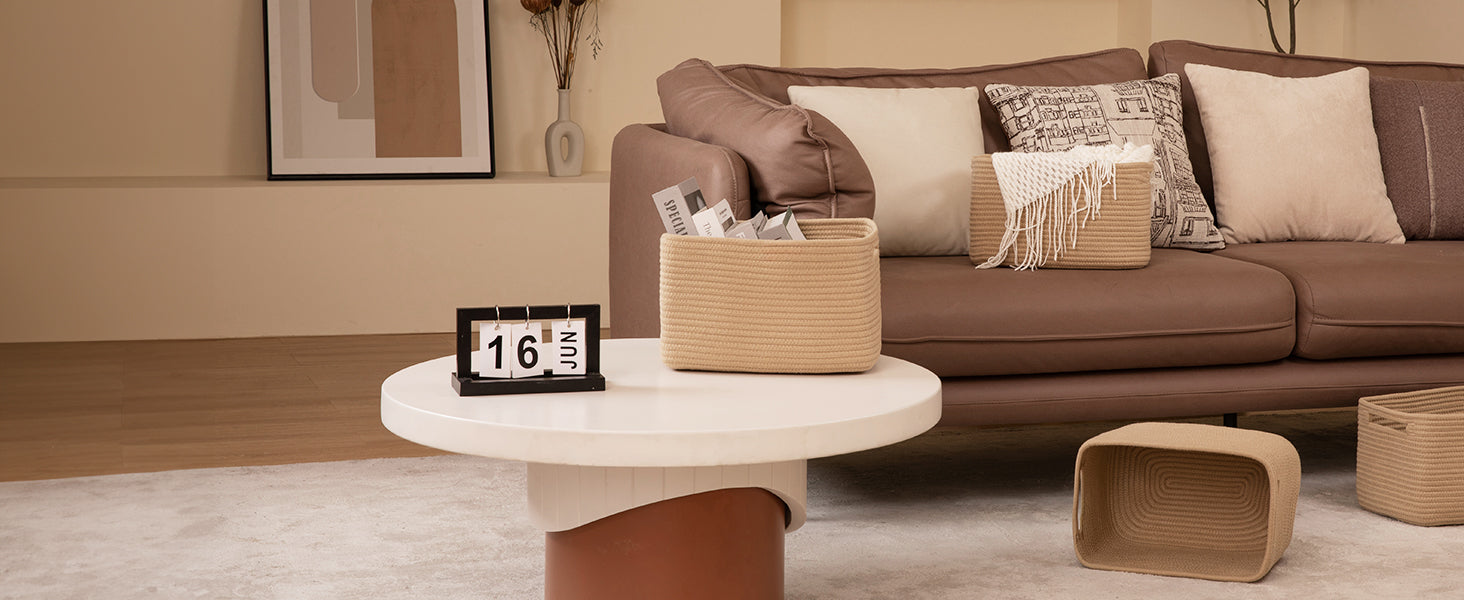
This is where the cotton rope basket ceases to be a laundry accessory and becomes the apex predator of playroom storage.
I tested a 20-inch diameter rope basket against a standard wooden toy chest. The wooden chest has a lid that pinches fingers and sharp corners that seek out toddler foreheads. The rope basket? It’s soft. A child can trip over it, fall into it, or wear it as a hat, and no trip to the ER is required.
Furthermore, the "give" in the rope material is critical. Children's books come in stupid sizes. Some are massive squares; others are tiny boards. Rigid boxes leave dead space. A flexible basket adapts to the weird geometry of Maps by Aleksandra Mizielińska just as easily as it holds a handful of tiny Mr. Men books. It swallows the chaos.

The Deep Reader’s Dilemma: Structural Integrity vs. Aesthetics
For the serious reader—the person who actually cracks spines rather than just styling them—most furniture is inadequate. You are likely dealing with the "Double Layering" shame, where you shove less prestigious paperbacks behind the nice hardcovers because you ran out of linear feet in 2019.
The Problem with the "TBR" Pile

Every deep reader has a "To Be Read" (TBR) pile. Usually, this lives on the nightstand. Inevitably, it grows until it becomes a leaning tower of guilt that crashes down when you reach for a glass of water.
You cannot organize a TBR pile on a shelf because, psychologically, once a book goes on the shelf, it is "filed away." It becomes static. The TBR pile needs to remain mobile and visible.
Stop stacking them on the floor. It looks like you just moved in and gave up.
This is the second scenario where I grudgingly admit the woven hamper shelf basket is superior to a side table. By placing a low-profile, wide-mouth basket next to your reading chair, you create a "current active zone." It contains the sprawl. You can toss the book in from three feet away (we all do it). It keeps the dust bunnies off the bottom book cover. It defines the boundary of your backlog. If the basket is full, you are not allowed to buy more books. That is the rule. (I know you will break it, but at least the rule exists).
Billy vs. The World

I will say this once: The IKEA Billy is fine. It is the Toyota Camry of book storage ideas. But if you are putting heavy art books or high-density textbooks on it, you must reinforce the back panel. The thin cardboard backing provides the shear strength; if it pops out, your library racks.
If you have the budget, metal shelving is superior. It doesn't warp. Wood moves with humidity; steel does not care about your leaky humidifier.
The Aesthetic/Lifestyle Follower: Stop Color-Coding Your Books

I have a special reserve of venom for the "Rainbow Shelf" trend. Organizing books by color is the hallmark of someone who treats literature as wallpaper. It renders the collection useless. "Honey, where is that book on the history of the salt trade?" "Oh, it's in the Blue Section."
Do you know how many books are blue? Half of them.
If you are a lifestyle aesthete, your storage problem is likely "Coffee Table Books." These are massive, heavy, and expensive to print. They are meant to be seen, but they are often too large for standard shelving depths (typically 11 inches).
The "Horizontal Anchor" Technique
Do not try to stand a 15-inch tall oversized fashion monograph upright on a standard shelf. It will stick out like a sore thumb and eventually warp its own binding under the gravitational pull.
Store these giants horizontally. Use them as risers. But here is the trick: do not stack them more than three high. Any higher, and you will never look at the bottom book again because it is too much effort to move the top ones.
If you are a minimalist, you probably hate visual noise. You might be tempted by the "Backward Book" trend (spine facing the wall, pages facing out). This is psychopathic behavior. It creates a wall of beige anonymity. If you hate the look of books, why do you own them? Get a Kindle.
For the minimalist who must keep physical copies, you need concealed storage. Sideboards. Credenzas. Or, honestly, a very clean, uniform row of woven rope bookshelf baskets on a lower open shelf. The texture of the rope provides visual warmth without the chaotic typography of 500 different book spines screaming for attention. It turns a library into a texture study.

Small Space Survival: The "Renter's Library"
Renters have it the worst. You cannot build custom floor-to-ceiling built-ins. You have to move these heavy boxes every two years.
The "Tetris" Method of Crate Storage

If you move frequently, buying a massive, heavy bookcase is masochism. You need modularity. The "lawyer's bookcase" (stackable glass-fronted units) was invented for this, but they cost a fortune.
The modern alternative is the crate system. But avoid the plastic milk crate; you look like a college student. Use wooden wine crates or high-quality modular cubes. However, these lack the "cozy" factor.
In a studio apartment, "book storage" often overlaps with "bedroom storage." You don't have the luxury of a dedicated library wall. This is where hybrid storage becomes essential.
I have seen people successfully use the space under a bench or a console table. This is a dust trap zone. If you line up books directly on the floor under a table, they will be ruined by the vacuum cleaner.
Put them in a container.
I’ve used a set of three large cotton rope baskets under a console table in a hallway. One for fiction, one for non-fiction, one for magazines. You can slide the basket out with one hand (the rope handles are actually functional, unlike the decorative holes in cardboard boxes), grab your book, and slide it back. It protects the books from the vacuum, hides the spine chaos, and adds a textile element to the room that absorbs sound—something small apartments desperately need.
The "Bathroom Library"
We all do it. Or at least, enough of us do it that it warrants a mention. Storing books in a humid environment is a crime against paper conservation, but if you insist on having reading material in the powder room, do not stack it on the toilet tank. That is disgusting.
You need a vertical magazine rack or a small, dedicated vessel. A small, soft basket on a shelf is ideal here because it breathes. Humidity trapped in a plastic container in a bathroom will turn your copy of The New Yorker into a wavy, moldy mess within weeks. Cotton breathes. It allows the moisture to dissipate rather than condensing on the paper.
Conclusion: Stop Curating, Start Containing
The internet is flooded with book storage ideas that are purely performative. They show five color-coordinated books on a floating shelf surrounded by eucalyptus leaves. That is not storage; that is decoration.
Real readers have volume. Real families have chaos. Real minimalists have anxiety about visual clutter.
Stop trying to force your library into a Pinterest template. If you have a thousand books, buy steel shelving. If you have a toddler, stop buying wooden chests and get a soft, indestructible cotton rope basket that can swallow the mess. If you are a minimalist, hide the spines behind texture.
Your books are there to be read, not just to match your throw pillows. Respect the weight, respect the dust, and for the love of God, stop turning the spines toward the wall.